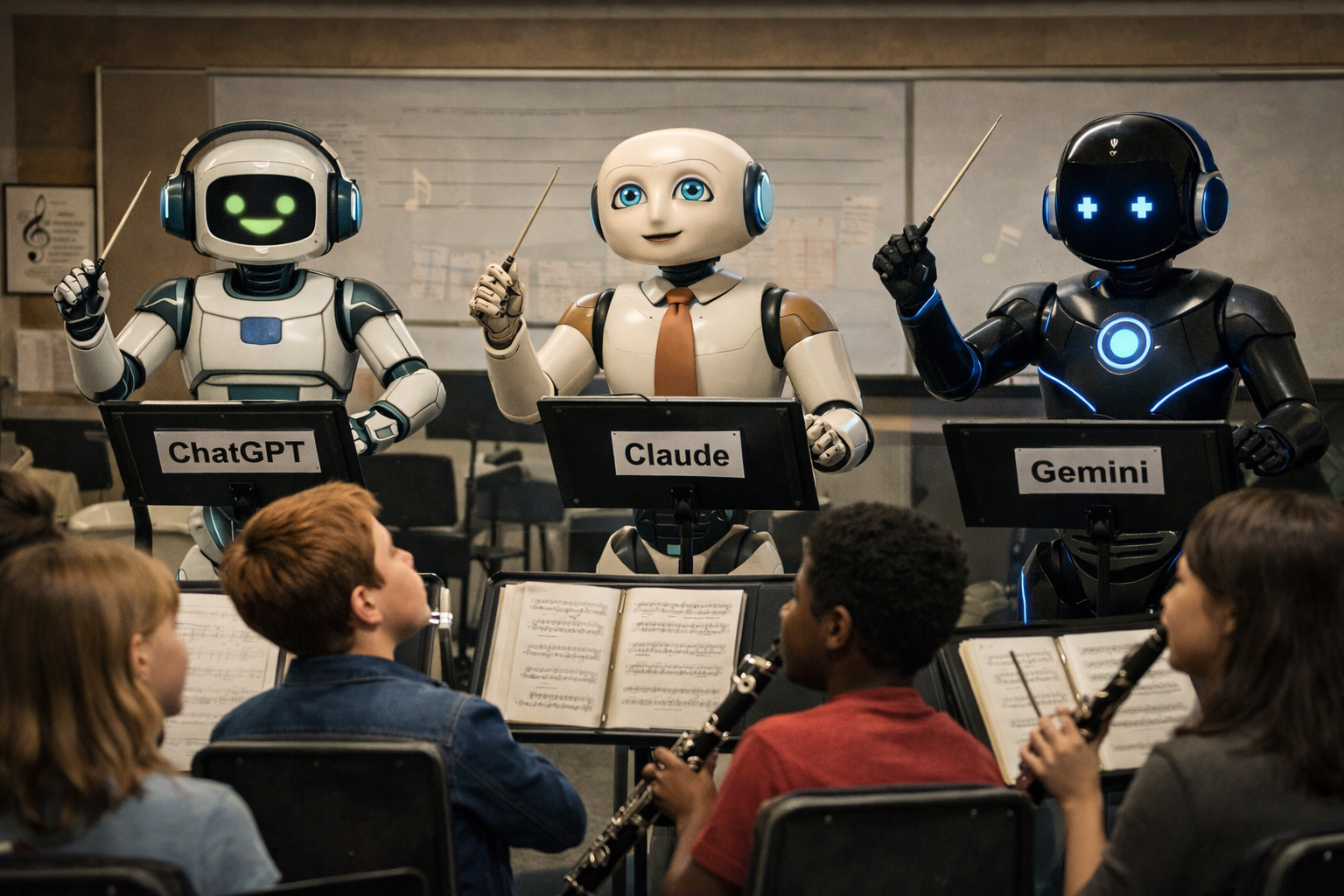
ChatGPT, Gemini, and Claude Walk Into a Music Class…
SYoo, H. (2026). Research-to-Resource: Preparing Music Teachers for AI—The AI Literacy Model. Update: Applications of Research in Music Education, 0(0). https://doi.org/10.1177/02557614251328171
AI is already in the room, so music teachers need to know when to use it, when to question it, and when to tell it to take a seat.
-
Overview
Like it or not, AI is here to stay! This article makes the case that AI literacy needs to be part of music teacher preparation. AI is already showing up in how students write, create, compose, search, remix, and problem-solve. So the question is not really “Should music teachers use AI?” The better question is: how do we prepare teachers to understand AI well enough to use it responsibly?
Yoo introduces an AI Literacy Model specifically for preservice music teachers. The goal is to:
1.) Help them understand what AI is
3. Try it in meaningful ways
3.) Evaluate whether it is actually useful, and
4.) Think through the ethical issues that come with using it in music classrooms.
-
Summary
Yoo’s model has two main parts. The first part focuses on what music teachers should learn about AI: knowing what the tools are, try the tools, question the tools, and think about the consequences.
The second part focuses on how teachers learn this through three roles: observer, participant, and agent.
As observers, preservice teachers learn basic AI terms and notice how AI is already shaping education and the arts.
As participants, they experiment with AI tools for things like music creation, lesson planning, visuals, storytelling, and classroom materials.
As agents, they make decisions about whether a tool is accurate, appropriate, inclusive, ethical, and actually connected to the musical learning goal.
-
So What?
For music teachers, this is a good reminder that AI should not be the lesson. The music should still be the lesson. AI might help students compose, generate ideas, analyze performances, create visuals, or revise work, but the teacher has to keep asking: What musical thinking are students doing?
This model could also work with students. First, help them understand what AI is. Then let them experiment with it. Then ask them to make judgments about the results. Is it musical? Is it original? Is it biased? Who gets credit? What did the human contribute?
AI literacy may become part of musicianship. Not because AI replaces listening, creating, practicing, or performing (no, thanks!), but because students will need to make informed musical and ethical choices in a world where these tools are already in the room.
-
Mike's Riff
What I like about this article is that it does not frame AI as either “the future of everything” or “the end of real learning.” It lands in a more useful place: music teachers need enough AI literacy to make good decisions.
There are real possibilities for AI as an assistant to both teachers and students. For example: Create a practice routine to improve double tonguing at 172 BPM. Give me ideas for pieces to program for a pops concert on the theme of “Hope.”Help me write program notes or announcement scripts for students to read at our concert. Is it always perfect? Absolutely not. But it can give us a place to start, and sometimes that starting point is exactly what we need!
I also think we need to lean into the potential AI has in creative spaces, not as a replacement for human creativity, but as a tool for better questions. Why does this sound like AI and not like a human created it? What does AI get right? What does it get wrong? What musical choices still need a person behind them?
Those are the kinds of conversations that can push students into higher-level thinking and more meaningful musical discourse. And honestly, I am always looking for better ways to do that.
*Assisted with AI